
There is a particular sound that has become part of everyday life in Nigeria. The power goes out. A few minutes later, a generator starts somewhere nearby. Then another.
And another. For many households and small businesses, this is simply how you stay cool, keep your freezer running and get through the day. But there’s a question we don’t ask often enough:
How much are we actually spending to keep cooling appliances running when the grid goes off? The answer is bigger than the price of petrol.
Nigeria’s electricity problem has a very real price
The World Bank estimates that unreliable electricity supply costs Nigeria’s economy around ₦7–10 trillion every year, equivalent to roughly 5–7% of GDP in the assessment. The same analysis estimated that more than 22 million petrol and diesel generators were being used by households and small businesses. (World Bank)
That’s a staggering amount of backup power. But look beyond the national numbers and the problem becomes much more personal. A household doesn’t experience “₦10 trillion in economic losses.”
It experiences another trip to buy petrol. Another generator service. Another freezer that needs to be switched on. Another night spent trying to sleep through the heat.
And cooling is one of the appliances we need most
You can probably live without a television for a few hours. You can postpone charging some devices. But when it’s 2pm, the room is hot and humid, and the electricity disappears, a fan suddenly becomes very important.
The same applies to refrigeration. If you’ve just stocked your freezer with meat, fish, chicken and other food, you don’t necessarily want to leave it without power for hours.
So the generator gets switched on. And this is where the economics become interesting. You’re not necessarily running a generator because you need electricity for your entire house. Sometimes you’re running it because you need one or two essential appliances.
What if you didn’t need to power everything?
This is the question more Nigerians should be asking. Instead of thinking about backup power as one large system for the entire home, think about the appliances you absolutely need to keep running. For many households, cooling would be near the top of that list.
A solar fan can provide ventilation without requiring petrol. A solar freezer can keep food cold without requiring you to start a generator every time the grid goes down. That doesn’t mean you have to throw your generator away. It means you don’t have to use it for everything.
Nigeria is already showing an appetite for solar
The transition isn’t theoretical.
The World Bank’s 2023–2024 Nigeria General Household Survey shows that households are already using a mix of electricity sources, including generators, solar home systems, solar lighting systems, rechargeable batteries and other alternatives. (microdata.worldbank.org)
And Nigeria’s energy transition is attracting increasingly large investments in distributed renewable energy.
The country’s National Energy Compact reports at least 2.93 million solar home systems installed over the previous three years and identifies distributed renewable energy as an important part of reaching its energy goals. (World Bank)
People aren’t necessarily waiting for one perfect solution. They’re finding ways to make their homes and businesses more resilient.
Solar doesn’t have to replace your entire electricity supply
This is where the conversation around solar sometimes becomes unnecessarily complicated. You don’t always need to put your entire home on solar.
You can start with what matters most. If staying cool is a priority, start with cooling. If protecting frozen food is important, start with refrigeration. If you run a small shop, start with the appliances that directly affect your business.
The goal isn’t necessarily to become completely independent of the grid overnight. It’s to make the grid less capable of disrupting your day.
There’s another benefit: fewer hours running the generator
Every time you don’t need to start your generator, you avoid more than fuel consumption. There’s less noise. Less maintenance. Less engine oil. Less exposure to generator fumes.
And one less thing to worry about during a blackout. For a household that uses a generator primarily to keep a fan or freezer running, that difference can become meaningful over time.
The sun is already doing its part
There’s an interesting irony here.
The same Nigerian afternoon that makes you desperately want a fan is also the period when solar panels can be producing electricity. Instead of buying petrol to fight the heat, you can use the energy that is already arriving from above. That’s the idea behind solar cooling.
It’s not about pretending Nigeria’s electricity challenges don’t exist. It’s about designing around them.
Cooling should work when you need it most
Power outages aren’t scheduled around your comfort. They don’t wait until the temperature drops. They don’t care whether you’ve just filled your freezer with groceries.
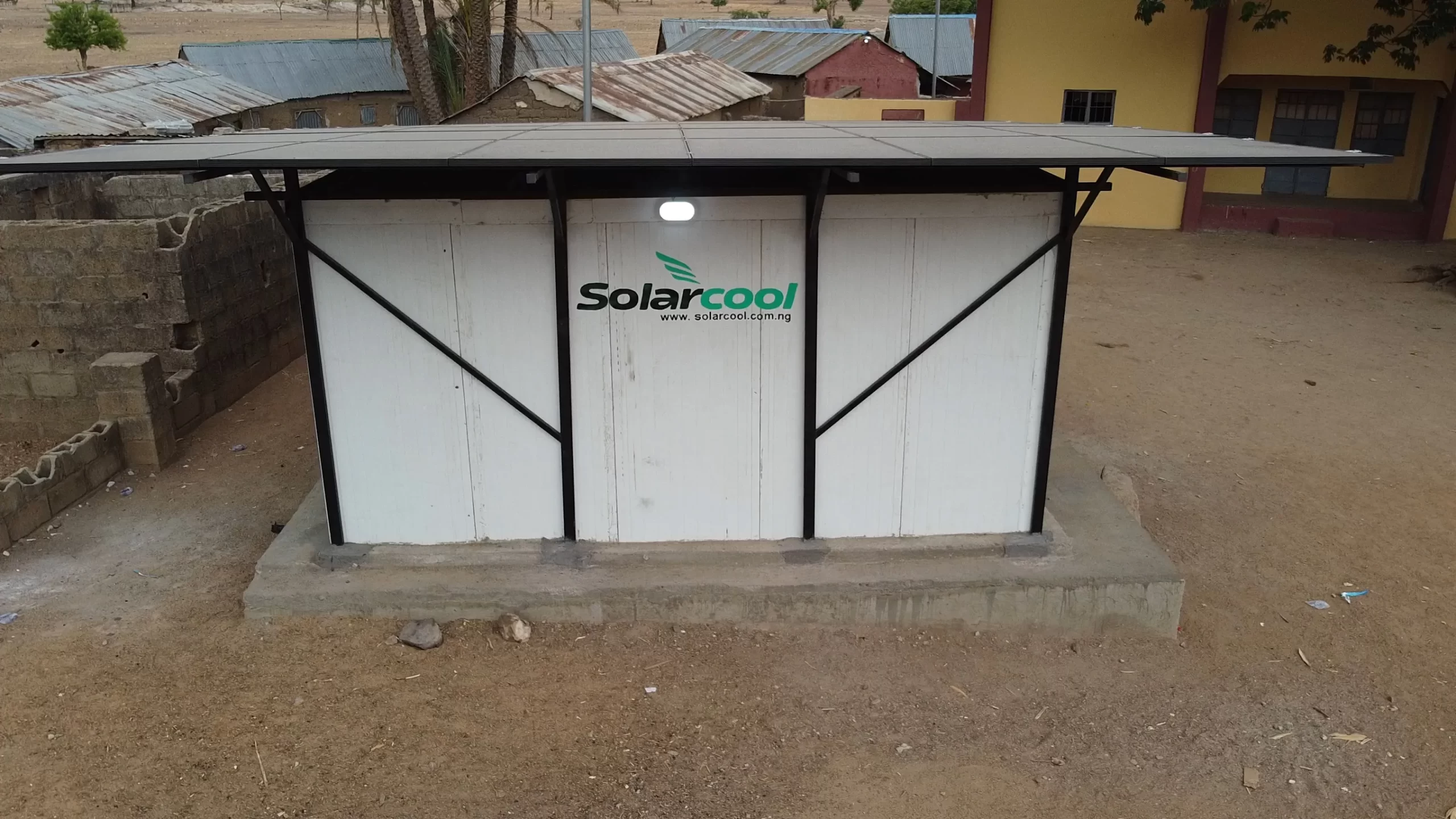
And they certainly don’t care whether you have enough petrol at home. Your cooling shouldn’t have to be completely at the mercy of them either. At Solarcool, we’re building practical solar cooling solutions for exactly this reality—helping Nigerian homes and businesses stay cool and keep food preserved while reducing their dependence on grid electricity and fuel-powered generators. The next time the power goes out, the question doesn’t have to be “Where’s the petrol?”
It could be:
“How much of my cooling can I take off-grid?”